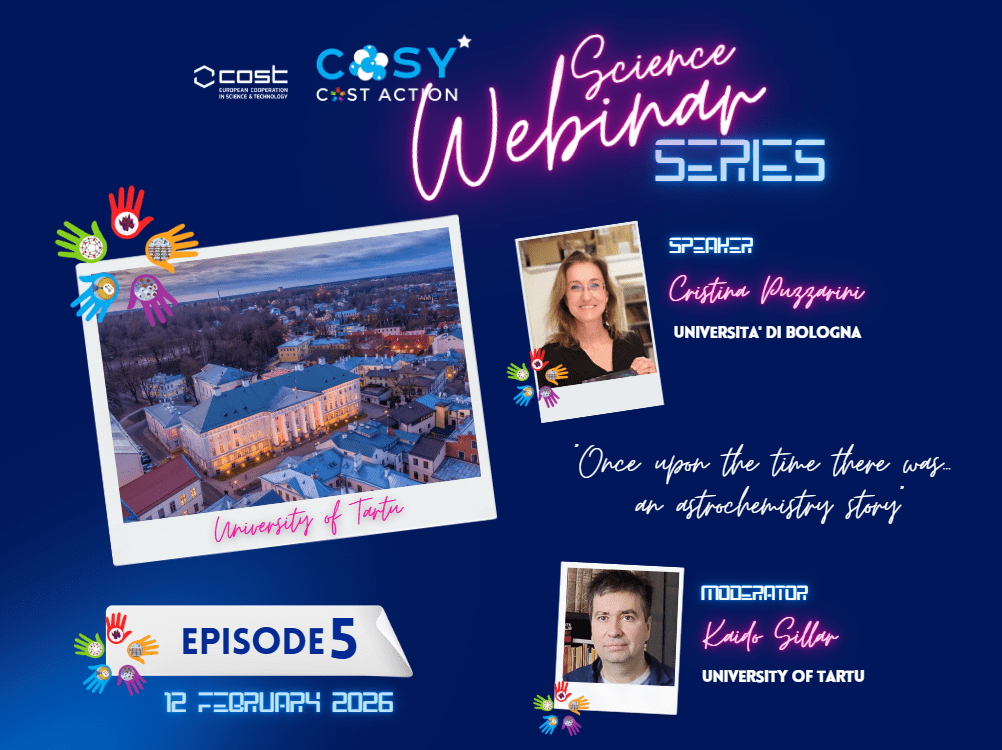
Once upon the time there was … an astrochemistry story
Cristina Puzzarini. Dept. Chemistry “Giacomo Ciamician” University of Bologna, Bologna, 40129, Italy.
The discovery of an increasing number of complex organic molecules in the interstellar medium (ISM) raises fundamental questions about how chemical reactivity can proceed efficiently under extreme astrophysical conditions characterized by very low temperatures, low densities, and pervasive ionizing radiation [1]. Under such conditions, conventional chemical intuition fails, and a detailed molecular-level understanding becomes essential. In this context, computational chemistry plays a central role in identifying viable reaction pathways and providing quantitative kinetic data for astrochemical modeling.
This seminar tackles the challenge of the interstellar chemistry and addresses the strategy to unveil it. The starting point is the quantum-chemical exploration of reactive potential energy surfaces (PESs) relevant to interstellar chemistry [1]. High-level electronic structure methods, ranging from density functional theory to coupled-cluster-based composite schemes, enable accurate characterization of pre-reactive complexes, submerged transition states, and exothermic bimolecular products that satisfy the stringent constraints imposed by the ISM [1-5]. Particular emphasis is placed on automated and semi-automated PES exploration workflows, which systematically identify all energetically accessible reaction channels while enforcing interstellar-specific conditions such as barrierless entrance pathways and bimolecular stabilization [6].
The resulting energetic data are coupled with kinetic simulations to compute temperature-dependent rate coefficients and branching ratios in the temperature range of interest to astrochemistry. Case studies demonstrate that even small energetic differences can lead to variations in reaction rates of several orders of magnitude at cryogenic temperatures, underscoring the need for highly accurate computations [1-5]. These theoretical results provide critical input for astrochemical reaction networks, significantly improving their predictive capability.
In addition, we discuss current computational strategies for modeling chemistry on interstellar grain analogues, including surface reactions and the formation of complex organic and prebiotic molecules in icy environments. While surface chemistry is increasingly well described [7], modeling bulk-ice reactivity remains a major theoretical challenge [1]. Overall, the integration of advanced quantum chemistry, automated reaction discovery, and kinetic modeling is transforming astrochemistry into a predictive, quantitatively grounded discipline.
References
- Puzzarini, S. Alessandrini, ACS Cent. Sci. in press (2026). DOI: 10.1021/acscentsci.5c02122
- Ye, S. Alessandrini, C. Puzzarini, MNRAS 525 (2023) 1158.
- Ye, S. Alessandrini, C. Puzzarini, Astrophys. J. 962 (2024) 32.
- Alessandrini, H. Ye, C. Puzzarini, ACS Earth Space Chem. 9 (2025) 1217.
- Alessandrini, H. Ye, M. Melosso, C. Puzzarini, J. Phys. Chem. A in press (2026). DOI: 10.1021/acs.jpca.5c06889
- Bensberg, S. Alessandrini, M. Melosso, C. Puzzarini, M. Reiher, Astrophys. J. in press (2026). DOI: 10.3847/1538-4357/ae2d0a
- Perrero, S. Alessandrini, H. Ye, C. Puzzarini, A. Rimola, Astron. Astrophys. 698 (2025) A51.
Join Zoom Meeting
https://urldefense.com/v3/__ht
Meeting ID: 958 6758 4126
Passcode: 923407