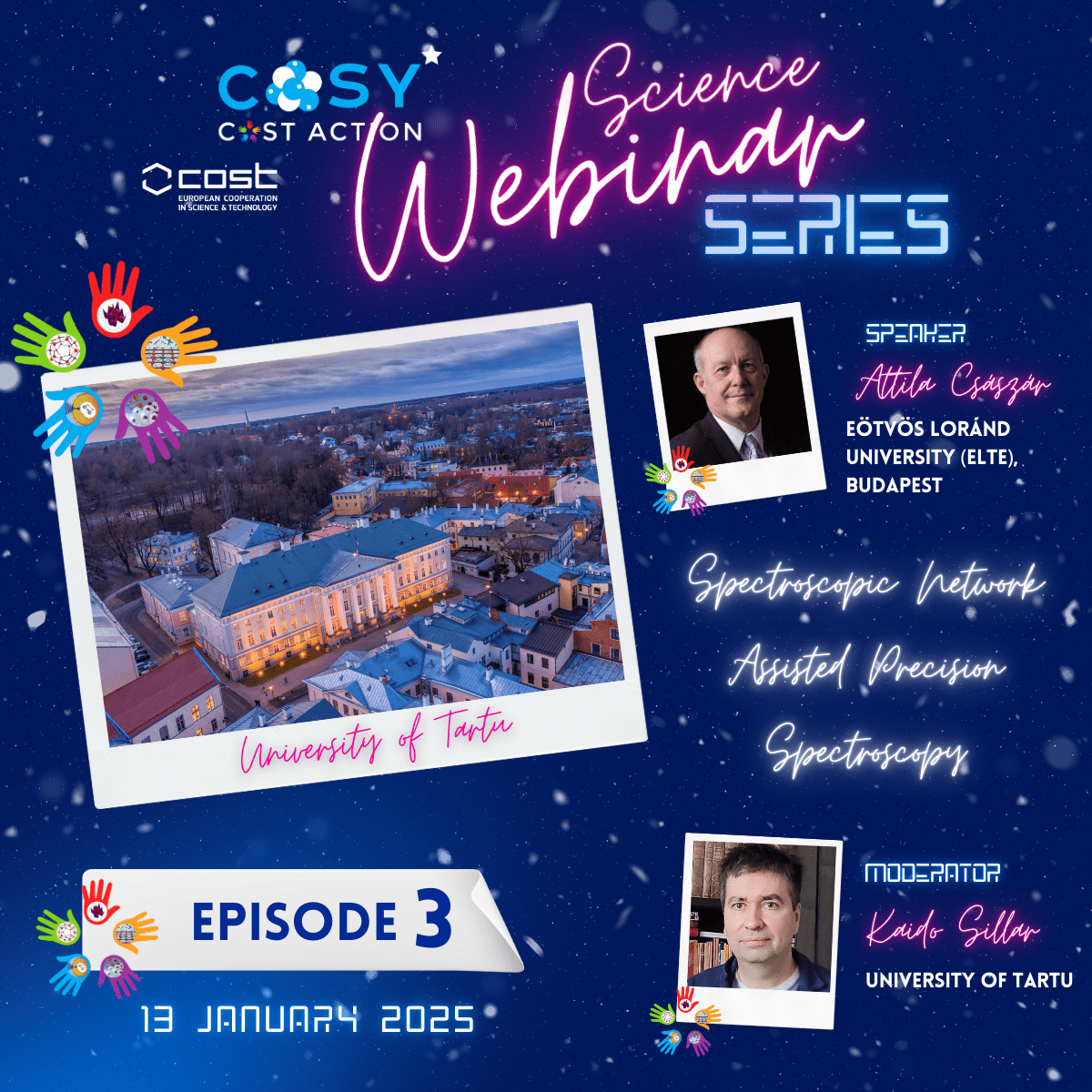
Spectroscopic Network Assisted Precision Spectroscopy
Prof. Dr. Attila G. Császár, PhD, DSc
Eötvös Loránd University (ELTE), Budapest, Hungary
Apart from few-body problems, first-principles quantum-chemical computations, with or without the Born-Oppenheimer approximation, are unable to come even close to the accuracy of modern rovibrational spectroscopic measurements. The situation improved, but did not change fundamentally during the last half of a century. To help experimentalists designing and assessing their precision-spectroscopy measurements, the field of graph or network theory, that is discrete mathematics, comes to the rescue. Briefly, in the case of high-resolution spectroscopy, instead of relying on full of simplified Hamiltonians, one can come up with a theory built only on the validity of the Ritz principle (that is the discreteness of both the transitions and the energy levels). In fact, a spectroscopic network, a graph G(V,E,w), can be formed from the line-center positions of spectroscopic measurements, whereby the vertices V are the quantum states, the edges E are the transitions connecting them, and w is some weight function. Interestingly, the degree distribution of spectroscopic networks built upon measurement results is highly similar to those of complex human networks (e.g., the internet, social networks, and air traffic), in that it is characterized by a few vertices with very large degree counts, called hubs, and a lot of vertices with just a few degrees (thus, quantum mechanics also “builds” an almost scale-free network). The network view of spectroscopic measurements led to the development of a special tool, MARVEL, standing for Measured Active Rotational-Vibrational Energy Levels, which helps not only to analyze high-resolution spectra of molecules but also to improve large spectroscopic line-by-line databases, like HITRAN. Using the MARVEL workflow, one inverts the direct spectroscopic information ending up with empirical energy levels with well-defined uncertainties, truly reflecting the accuracy of the measurements. In a way these empirical/MARVEL energy levels allow the representation of all the measurements made for a given molecule and, furthermore, they can predict transitions with experimental accuracy. The same spectroscopic-network approach can be used to select target lines for precision-spectroscopy measurements, where the measurement of each line still takes a considerable effort. Thanks to Spectroscopic Network Assisted Precision Spectroscopy, hubs of several water isotopologues as well as of parent acetylene have become known with kHz accuracy (in this case hubs are defined as the top 1% of quantum states with the largest number of measured transitions).
References
https://doi.org/10.1038/s41467-020-15430-6: R. Tóbiás, T. Furtenbacher, I. Simkó, A. G. Császár, M. L. Diouf, F. M. J. Cozijn, J. M. A. Staa, E. J. Salumbides, and W. Ubachs, Spectroscopic-Network-Assisted Precision Spectroscopy and its Application to Water, Nat. Commun. 2020, 11, 1708.
https://doi.org/10.1063/5.0052744: M. L. Diouf, R. Tóbiás, I. Simkó, F. M. J. Cozijn, E. J. Salumbides, W. Ubachs, and A. G. Császár, Network-Based Design of Near-Infrared Lamb-Dip Experiments and Determination of Pure Rotational Energies of H218O at kHz Accuracy, J. Phys. Chem. Ref. Data 2021, 50, 023106.
https://doi.org/10.1080/00268976.2022.2050430: M. L. Diouf, R. Tóbiás, T. van der Schaaf, F. M. J. Cozijn, E. J. Salumbides, A. G. Császár, and W. Ubachs, Ultraprecise Rovibrational Energies in the (2 0 0) Vibrational Band of H216O, Mol. Phys. 2022, 121, e2050430.
https://doi.org/10.1364/OE.474525: M. L. Diouf, R. Tóbiás, F. M. J. Cozijn, E. J. Salumbides, C. Fábri, C. Puzzarini, A. G. Császár, and W. Ubachs, Parity-Pair-Mixing Effects in Nonlinear Spectroscopy of HDO, Opt. Expr. 2022, 30, 46040-46059.
https://doi.org/10.1039/d3cp01835k: A. Castrillo, E. Fasci, M. Asad Khan, S. Gravina, L. Gianfrani, T. Furtenbacher, and A. G. Császár, 12C2H2 Near-Infrared Spectrum: Absolute Transition Frequencies and an Improved Spectroscopic Network at the kHz Accuracy Level, Phys. Chem. Chem. Phys. 2023, 25, 23614-23625.
https://doi.org/10.1038/s42004-024-01103-8: R. Tóbiás, M. L. Diouf, F. M. J. Cozijn, W. Ubachs, and A. G. Császár, All Paths Lead to Hubs in the Spectroscopic Networks of Water Isotopologues H216O and H218O, Comms. Chem. 2024, 7, 34.
https://doi.org.10.1021/acsearthspacechem.4c00161: W. Ubachs, A. G. Császár, M. L. Diouf, F. M. J. Cozijn, and R. Tóbiás, A Network Approach for the Accurate Characterization of Water Lines Observable in Astronomical Masers and Extragalactic Environments, ACS Earth Space Chem. 2024, 8, 1901-1912
Registration
Meeting link
Meeting ID: 999 7067 1673
Passcode: 352080